
Active Surveillance
Regular tests instead of immediate treatment when the cancer is slow-growing.


Fill in your details and our care team will call you back shortly.
Comprehensive care for
Screening and treatment planning tailored to every stage of prostate cancer.
Karuna Cancer Centre offers a holistic treatment for Prostate cancer, This is a type of cancer which affects the prostate and is a prominent part of the human body. Prostate cancer is a common type of cancer in males. It develops in the prostate gland, located between the penis and the bladder. It is highly curable in its early phases. Utilizing advanced medical technology, the Karuna Cancer Centre has a purpose of serving all the patients with the advanced technology treatment and compassion. Committed to excellence and compassionate care, the Karuna Cancer Centre strives to empower patients in their fight against prostate cancer.
Some of its roles include supplying the fluid that nourishes and carries sperm, secreting prostate-specific antigen (PSA), a protein that helps semen retain its liquid condition, and assisting with urine control.
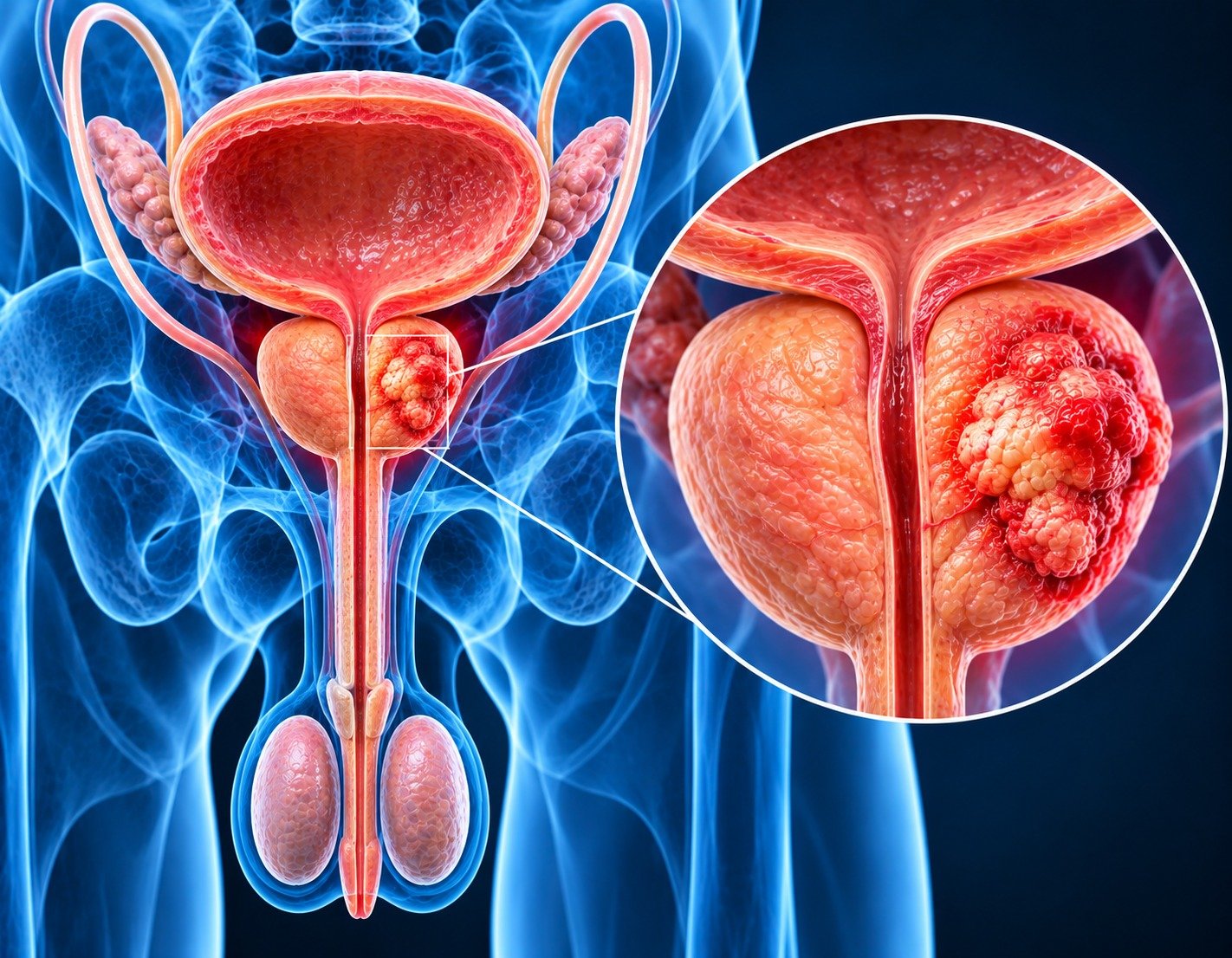
Prostate cancer begins when cells in the prostate gland start to grow out of control. The prostate gland found only in males makes some of the fluid that nourishes and carries sperm.
The prostate is below the bladder (the organ where urine is stored) and in front of the rectum. Just behind the prostate are glands called seminal vesicles, which make most of the fluid for semen. Prostate cancer is the most common type of cancer in males. Many prostate cancers grow slowly and are enclosed in the prostate gland, where they may not cause serious harm. There are some types of prostate cancer grow slowly and may need minimum or even no treatment, other types are aggressive and can spread quickly.
The exact causes of prostate cancer are not known, the following factors are linked to a increased risk of prostate cancer:
Prostate cancer grows slowly in many cases. Thus, Low-grade prostate cancers can be treated with a watchful waiting or active monitoring strategy. It means that the cancer condition is closely watched and by keeping track of the changing symptoms and regular tests determine the best course of action.
The type of surgery depends on the disease’s stage, the patient’s overall condition, and other factors.
The entire prostate, as well as the seminal vesicles, are removed surgically in radical prostatectomy. It is also possible to remove lymph nodes in the pelvic area. Sexual function can be affected because of this medical procedure.
If possible, nerve-sparing surgery improves a man’s chances of maintaining sexual function. Because these are independent processes, orgasm can occur even if some nerves are damaged. Radical prostatectomy can cause urinary incontinence. The doctor may prescribe drugs, penile implants, or injections to restore normal sexual function. Urinary incontinence can sometimes be treated with another procedure.
This procedure is less intrusive and ensures faster recovery. The surgeon inserts a camera and tools into the patient’s abdomen through small keyhole incisions.
Then, the surgeon uses robotic devices to remove the prostate gland. The sexual and urinary side effects of robotic prostatectomy are comparable to those of a radical (open) prostatectomy.
Removal of both testicles surgically is known as bilateral orchiectomy.
To use TURP there is a common reason to ease the symptoms of a urinary blockage, not to cure prostate cancer. A surgeon inserts a small tube with a cutting device called a cystoscope into the urethra and the prostate to remove prostate tissue.
Tumour board where surgical, medical and radiation oncologists review every case together
Diagnosis, treatment and follow-up available under one roof
Personalised treatment plan based on the exact type and stage
24x7 emergency response, ICU and in-house blood bank
Compassionate, affordable care with a dedicated patient coordinator
Second opinions and regular follow-up visits explained in plain language
Choose an area to see how our team approaches it.
PSA testing and MRI for men at risk.
Radical prostatectomy with attention to urinary and sexual function.
External beam radiation and other precision options.
Androgen deprivation and newer medicines.
Careful monitoring for very low-risk disease.
Your plan may use one or a combination of these, decided together by your care team.
Regular tests instead of immediate treatment when the cancer is slow-growing.
Surgical removal of the prostate for localised cancer.
Cures many localised cancers without surgery.
Lowers male hormones that fuel prostate cancer.
For advanced disease that no longer responds to hormones.
These signs do not always mean cancer, but they should be checked by a doctor.
Early evaluation gives you more treatment options. Speak to a specialist today.
Accurate diagnosis and staging come first, so treatment is matched to your exact condition.
Measures a protein that rises in many prostate problems.
A quick examination to feel the prostate.
MRI guides a biopsy to confirm and grade the cancer.
Checks for spread in higher-risk disease.
CT, MRI, PET-CT and pathology are available in-house for faster reporting.
What to expect, from your first visit to long-term follow-up.
You meet the oncologist, share your history and reports, and ask every question you have.
The right tests confirm the diagnosis and show how far the disease has spread.
Specialists from every discipline agree on one plan, and your doctor explains it to you.
Surgery, medicines, radiation or a combination, with supportive care alongside.
Regular check-ups, rehabilitation and counselling to keep you well.
Experienced doctors who will guide your treatment.
Recovery journeys in our patients own words.
 Ankit Singh
 Sunita Singh
 Chote Lal
 Nikeeta Singh
Straight answers to what patients and families ask most.
Not necessarily. Infection and an enlarged prostate can also raise PSA, so it needs interpretation by a doctor.
These effects are discussed openly before treatment, and techniques and rehabilitation are used to reduce them.
No. Some slow-growing cancers can be safely monitored with active surveillance.
No referral is needed. You can book an appointment directly through the enquiry form or by calling our helpline, and our care team will guide you on the next steps.
Fill in the enquiry form on this page or call us. Our patient care coordinator will call you back and fix a convenient time with the right specialist.